How ABA Billing Services Improve Cash Flow for Therapy Practices

Cash flow is the quiet killer of growing ABA practices. You can deliver more sessions, hire more BCBAs, and still feel financially squeezed because the money you earned in March does not arrive until June. That gap between service and settlement is where most ABA practice owners spend sleepless nights.
Professional ABA therapy billing services exist to close that gap. Not by magic, but by systematically pulling five levers that shorten the revenue cycle: eligibility, authorization, claim quality, denial recovery, and A/R discipline. This post explains how each lever works and what the cash flow impact looks like in a typical mid-size clinic.
The Real Cost of Slow Cash Flow in ABA Practices
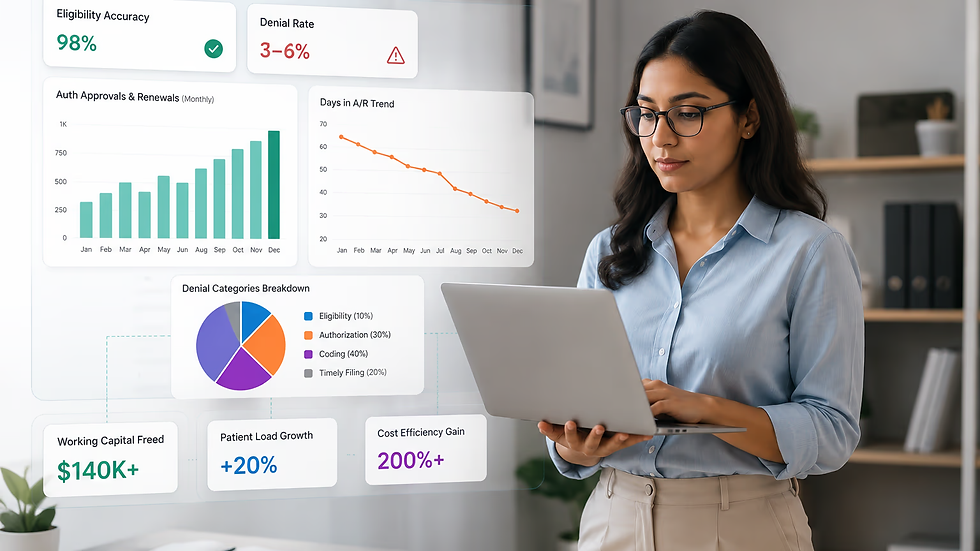
Before we discuss the fixes, it helps to understand what a slow revenue cycle actually costs. A clinic with $2M in annual collections and days-in-A/R of 60 is carrying roughly $330,000 in outstanding receivables at any given moment. If professional ABA billing services reduce that to 35 days, the clinic frees up approximately $140,000 in working capital no new revenue required, just faster conversion.
That working capital is what funds payroll on a slow week, new hires when you need them, and the location expansion you have been putting off. Cash flow is not a nice-to-have; it is strategy.
How ABA Billing Services Reduce Days in Accounts Receivable
Most cash flow problems don't start when a claim gets denied. They start weeks earlier during intake, authorization or claim prep. Professional billing services attack the revenue cycle at five specific pressure points.
Lever 1: Faster Eligibility Verification Prevents Claim Denials
Most cash flow problems start before the first session is ever billed. If eligibility was not verified correctly, every session that follows is either denied, delayed, or written off.
ABA billing services tighten this by:
Verifying benefits before intake for every new client
Re-verifying monthly for every active client (not just annually)
Documenting the plan details deductible, copay, coinsurance, authorization requirements in a structured format the billing team can actually use
Flagging plan changes the day they appear on an ERA
Cash flow impact: Denials related to eligibility drop from the typical 8–12% of claims to under 2%. Claims that would have been denied and re-worked instead pay on the first pass.
Lever 2: Proactive Authorization Management Eliminates Revenue Gaps
Nothing freezes cash flow faster than an authorization lapse. A client receives 40 hours a week of therapy, the authorization expires on the 15th of the month, and suddenly two weeks of sessions are unbillable until the renewal posts which can take another 30–60 days.
Strong ABA billing services run a live authorization calendar with three tripwires: 30, 14, and 7 days from expiration. The renewal packet is prepared in advance, submitted before the lapse, and tracked through approval. No gap, no unbillable sessions.
Cash flow impact: Unbillable session days drop to near zero. For a practice with $2M in annual revenue, eliminating even two weeks of unbillable time recaptures roughly $80,000 per year pure recovered cash.
Lever 3: Clean Claims Submission Improves First-Pass Payment Rates
The fastest-paid claim is a clean claim. The second-fastest is a clean claim. So is the third. In ABA, "clean" means:
Correct CPT and modifier combination for the payer
Unit counts that match session documentation exactly
Rendering and supervising providers mapped correctly
Place of service codes right for the setting (home, clinic, telehealth)
Timely filing well within the payer's window
Professional ABA billing services build claim-scrubbing rules that catch errors before submission. Instead of finding a mistake on a denial 45 days later, you find it on the pre-submission report 45 seconds after it is flagged.
At Pacemave, our current ABA client average is a 98.9% clean claims rate — well above the 92–95% professional services benchmark — which directly translates to faster payment cycles and fewer rework days.
Lever 4: Aggressive Denial Management Recovers Lost Revenue
Denials are not the end of the revenue cycle; they are a branch of it. The branch most clinics abandon.
ABA billing services treat denials as a workflow rather than an inconvenience. Professional denial management services is categorized (eligibility, authorization, coding, medical necessity, COB, timely filing) and routed to the right remediation path. Some get appealed. Some get corrected and resubmitted. Some reveal a systemic issue upstream that gets fixed at the source.
The highest-impact move is making sure denials under $100 still get worked. These feel like rounding errors but they are signals of process issues, and in aggregate they add up to real money. Many of these small denials stem from common ABA billing mistakes that can be systematically eliminated once identified
Lever 5: Relentless A/R Follow-Up Reduces Aging Receivables
Aged receivables are the most expensive thing on an ABA clinic's balance sheet. Every day a claim sits in 60+ aging buckets is a day that inflation, opportunity cost, and the risk of timely-filing write-offs eat into your margin.
Professional AR management services run tight aging reports. ABA billing services run tight aging reports typically weekly and escalate systematically:
Claims over 30 days: payer status check
Claims over 45 days: payer call with specific claim numbers in hand
Claims over 60 days: escalation to a payer supervisor, and documentation for appeal if needed
Claims approaching the timely filing window: immediate escalation and, if necessary, legal preservation steps
Cash flow impact: The 90+ day A/R bucket, which often holds 15–25% of outstanding dollars in unoptimized clinics, typically drops to under 8% within six months of engaging professional billing services.
What Improved Cash Flow Looks Like with ABA Billing Services
Here is what a typical engagement with professional ABA billing services delivers in the first six months:
Days in A/R falls from 55–70 days to 30–40 days
Net collection rate rises from 88–92% to 96–98%
Denial rate falls from 10–15% to 3–6%
Authorization-related revenue loss goes to near zero
90+ day A/R bucket shrinks by half or more
These are the exact ABA billing KPIs you should monitor monthly to measure your billing partner's performance and protect your practice revenue.
How to Evaluate ABA Billing Services for Cash Flow Impact
Not every vendor delivers the results above. When evaluating ABA billing services, ask for evidence, not promises:
What is your average first-pass resolution rate across ABA clients? should be 92%+.
What is your median days-in-A/R for ABA clients at 12 months? be under 40.
How do you handle authorization renewals? Look for a structured 30/14/7-day workflow, not "we stay on top of it."
What percentage of denied claims do you recover? 60%+.
How do you report cash flow performance back to me? Expect a monthly revenue review with specific metrics, not a generic invoice.
If the vendor cannot answer with numbers, they are not running a tight enough operation to improve your cash flow.
When In-House Billing Might Still Make Sense
Outsourcing is not always the right move. A small clinic with one or two BCBAs, a single-payer mix, and a dedicated experienced biller can run a clean operation in-house. The trouble starts at scale when payer mix diversifies, volume grows, and your biller cannot stay specialized in every payer's quirks.
ABA billing services become a clear win when:
You are billing more than about $750K annually
You work with three or more commercial payers
Medicaid is in your mix
You are planning to open a second location
Your current days-in-A/R is above 45 and climbing
Below that threshold, in-house may still work well with the right systems and an experienced hire.
The Transition Cash Flow Bump from Professional ABA Billing
One detail clinic owner often miss: the transition to professional ABA billing services itself produces a short-term cash flow bump. A good partner opens the engagement by:
Auditing open A/R and working the most recoverable aged claims first
Refreshing every authorization to make sure nothing is close to expiring
Re-verifying eligibility across the entire active client list
Identifying silent underpayments on recent ERAs and submitting recoupment requests
This "cleanup wave" typically delivers a cash infusion in months two and three of the engagement, on top of the structural cash flow improvement that follows. Done right, professional billing services pay for themselves before the fee cycle even starts.
FAQ
How quickly will our cash flow improve after switching to ABA billing services?
The first measurable improvement typically shows up 45–60 days in, as cleaner claims hit their payment cycle. Structural improvements (days-in-A/R, denial rate) stabilize by month four to six.
Do ABA billing services work with our existing practice management system?
Yes, almost always. Reputable partners are fluent in the major ABA platforms and do not require you to switch software.
What does it actually cost, and is it worth it?
Typical pricing is 4–8% of collections. For a practice improving net collections by 6–10%, the service pays for itself and then some.
Professional ABA Billing Services: Your Cash Flow Solution
Cash flow in an ABA practice is not controlled by how many sessions you deliver. It is controlled by how fast those sessions turn into collected dollars. Every day shaved off the revenue cycle is working capital in your bank account.
Professional ABA therapy billing services shorten that cycle by running tighter eligibility, proactive authorizations, cleaner first-pass claims, aggressive denial recovery, and disciplined A/R follow-up. The result is a practice that grows without choking on its own growth.


