ABA Insurance Changes Mid-Treatment: How to Prevent Claim Denials When a Client’s Coverage Changes

To prevent ABA claim denials during treatment, document all measurement changes with supporting medical necessity, keep authorizations current and verify coding accuracy and clinical documentation before submitting claims. ABA insurance changes show up: late, verbal and after the claims are already out. Payers tie claims and authorizations to one plan on one date of service, so old details stop working the day coverage changes.
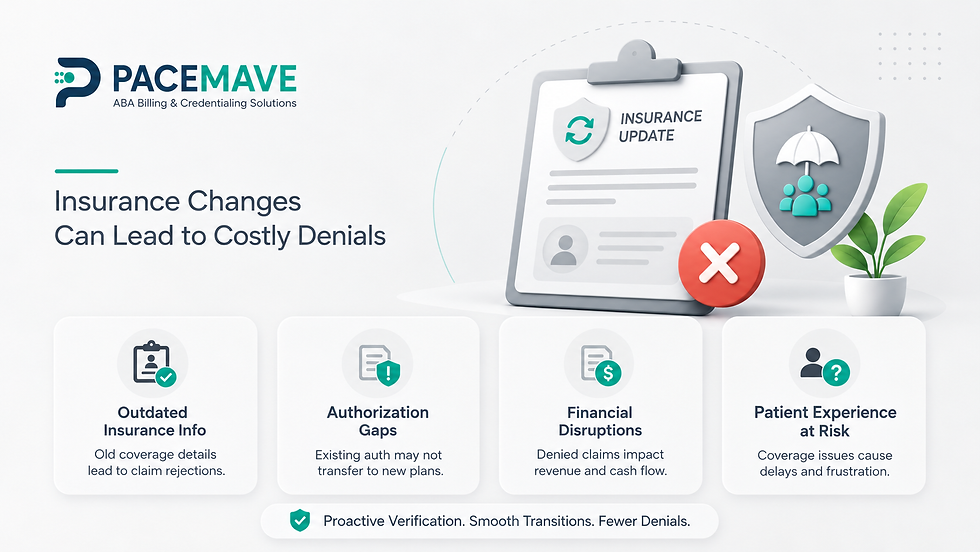
When a client’s insurance changes mid-treatment, treat it like a new intake. Reverify the new plan’s effective date, ABA benefits, network status and cost-sharing and confirm whether it needs a new authorization. Then sort every claim already sent by date of service so each one goes to the plan that was active that day.
Why claims fail after ABA insurance changes
Your remittance often spots the change before your front desk does. Watch for these X12 reason codes:
Code | What the payer is saying | What it usually means here |
CARC 27 | Service came after coverage ended | Old plan billed past its end date |
CARC 26 | Service came before coverage started | New plan billed too early |
CARC 31 | Patient can’t be identified as our insured | Old member ID or wrong payer |
CARC 22 | Another payer may be responsible | Primary and secondary order changed |
CARC 197 | Authorization absent | New plan never approved services |
A row of CARC 27s on one client means a change nobody logged.
Three types of ABA insurance coverage changes
Not every change means a new insurer and each type breaks something different.
Change type | What it looks like | What breaks | First move |
Policy change, same insurer | New group number, member ID or plan year, same carrier | Old ID on claims, reset deductible | Update the ID, recheck benefits |
New insurer | Different carrier, Medicaid to commercial or a new Medicaid MCO | Network status, authorization, payer ID | Full reverification, new auth request |
New plan administrator | Same employer plan, new TPA or behavioral health vendor | Claims address, payer ID, auth contact | Confirm where claims and auths now go |
The new insurer is the expensive one. If your practice isn’t contracted with that plan, sessions go out-of-network the day coverage starts and linking your BCBAs through ABA credentialing services can take months.
How to reverify insurance for ABA therapy before the next session
Check and document:
Effective date, member ID, group number and the payer ID claims go to
ABA coverage and whether the plan is self-funded (state autism mandates generally don’t bind those)
Network status for your group TIN and each rendering BCBA
Deductible, copay, coinsurance and out-of-pocket max, since a new plan usually restarts the deductible
Prior authorization rules for 97151, 97153 and 97155
Coordination of benefits, in case the old plan stays on as secondary
Save the call reference number and rep name. Our walkthrough of eligibility and benefits verification lists the full field set.
Tell the family about the new deductible now, not on a month-three statement.
ABA authorization after insurance change: does the old approval still count?
Usually not. An authorization belongs to the plan that issued it, so a new insurer generally means a new request with an updated treatment plan.
Medicaid has a safety valve. Under 42 CFR 438.62, every state must have a transition-of-care policy that protects members switching managed care plans from harmful gaps, and some states make the new MCO honor prior approvals for a set window. Commercial plans may accept a “continuity of care” request too.
Same insurer, new policy? Some carriers carry the approval over and some don’t, so get the answer with a reference number. Our guide to ABA therapy insurance coverage, authorization and claim denials shows how approval and payment rules connect.
How to fix an ABA claim denial after insurance change
Pull every claim dated after the old plan’s end date, then sort it:
Rejections (never accepted, like a bad member ID): correct the data and send to the right payer. No appeal needed.
Old-plan denials (CARC 27 or 31): don’t appeal. Rebill the new plan for dates it covered.
Old-plan payments after termination: expect a refund request or takeback. Here’s how refunds and recoupments hit cash flow.
Timely filing: the new plan’s clock started on each date of service and some commercial plans allow only 90 days.
Uncovered dates: talk with the family about self-pay or retroactive coverage before the balance ages.
Watch marketplace plans too. Under 45 CFR 156.270, if a family on premium tax credits stops paying, the plan pays month one of a three-month grace period and can hold claims for months two and three. Unpaid premiums end coverage back at month one.
A repeatable workflow for ABA billing eligibility issues
Trigger | Who acts | How fast |
Parent mentions a new job, card or plan | Front desk | Same day |
ERA shows CARC 26, 27, 31 or 22 | Billing team | Within 2 business days |
Medicaid renewal month or January plan year | Billing team | Before that month’s first session |
Every active client | Billing team | Monthly reverification |
Give one person ownership of this table, because unowned coverage changes become write-offs. That gap is what steady ABA billing services are built to close.
ABA insurance changes FAQs
Does an ABA authorization still apply after an insurance change?
Usually not when the insurer changes, because authorizations belong to the plan that approved them. The new plan typically needs its own request with a current treatment plan. Medicaid managed care members may get a transition-of-care window under 42 CFR 438.62 and some commercial plans accept continuity of care requests, so confirm in writing.
How do you fix an ABA claim denial after an insurance change?
Read the reason code first: CARC 27 means the old plan had ended and CARC 31 means the payer can’t match the member. Confirm the new plan’s effective date and rebill it with the new member ID before timely filing runs out. If the old plan paid sessions after termination, expect a refund request.
How often should you reverify insurance for ABA therapy?
Reverify every active client monthly, plus the same day a trigger appears, such as a new job or card, a remittance with CARC 26, 27 or 31, a Medicaid renewal month or a new plan year. ABA runs on long authorizations, so one missed change can expose weeks of sessions.
Treat ABA insurance changes like a new intake
ABA insurance changes come from job changes, Medicaid renewals and January resets and each one moves the rules under your claims. Catch the change early, reverify the same day, request new approvals and route every claim by date of service. Then a coverage switch costs a phone call, not a month of revenue.


