ABA Session Note Mistakes That Cause Insurance Denials (With Real Examples)

Updated: Jul 9
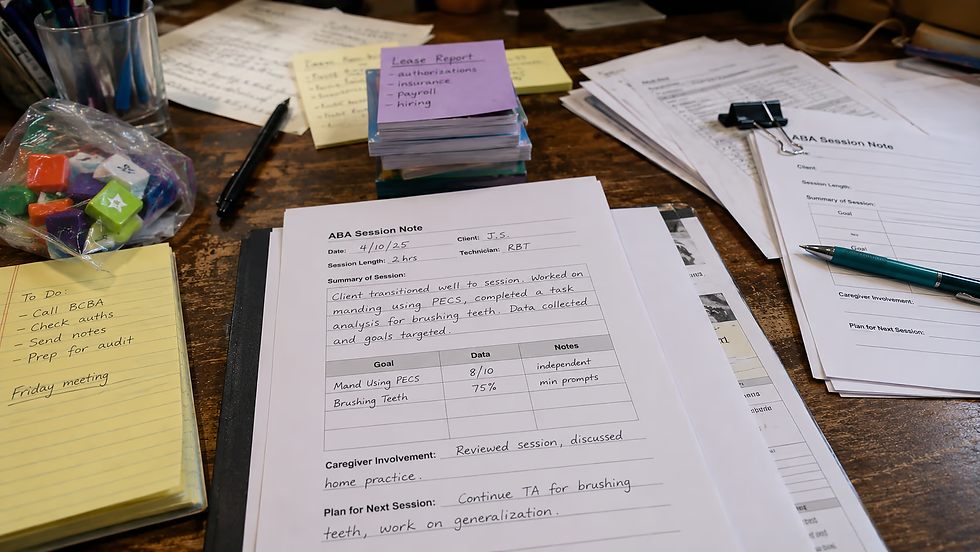
Your clinicians did the work. The session happened. The data was collected. But the claim still came back denied, and the reason wasn't the therapy. It was the note.
ABA session note mistakes are one of the most expensive and preventable sources of claim denials in behavioral health billing. A March 2026 OIG audit of Colorado's Medicaid ABA payments uncovered $77.8 million in improper payments. Most were not tied to fraud. They traced back to documentation failures: missing fields, vague language, cloned entries and notes that didn't connect to authorized services. These are happening inside clinics right now, usually unnoticed until a payer requests records.
This post breaks down the most common ABA session note mistakes that trigger denials, with real examples of what the wrong version looks like versus what passes payer review.
Why ABA Session Note Mistakes Lead Straight to ABA Claim Denials
Insurance companies don't pay for therapy. They pay for documented proof that therapy occurred, met medical necessity, and matched the authorized treatment plan.
The stakes in 2026 are higher than in years. Several large payers, including UnitedHealthcare/Optum, now run AI in healthcare through AI-assisted utilization review, which scans documentation for cloning, missing fields and generic language before a human reviewer touches the file. A note that passed two years ago can now trigger an automatic denial.
Cloned Notes: The ABA Documentation Error That Triggers Audits Fastest
Copying the prior session's note into the current one is the most common and most dangerous ABA documentation error a clinic can make. Payers call this "cloning," and they treat it as a fraud red flag even when the therapy was completely legitimate.
Wrong: "Client worked on skill acquisition targets. RBT implemented DTT protocols. Client responded appropriately. Session went well."
That sentence appearing across 12 notes for the same client in one month is an automatic audit flag. No data, no behavioral specificity, no proof the note reflects that date.
Right: "Client targeted manding for preferred items using DTT. 8 trials, 6 correct (75%). Full physical prompt needed on trials 3 and 7. Increased latency compared to Tuesday's session. BCBA supervision note attached."
It's a culture shift: every RBT treats each note as a unique clinical record, never a duplicate.
Missing Credentials: The ABA Billing Documentation Gap Payers Reject Instantly
Two fields cause a disproportionate share of ABA claim denials: the rendering provider's NPI and their credential level. When the NPI on the note doesn't match the enrolled NPI in the payer's system, the claim rejects. When an RBT-delivered session lacks the supervising BCBA's credentials, many payers deny the whole claim.
This matters by code. CPT 97153 (direct therapy by RBT) requires documented BCBA supervision. CPT 97155 (protocol modification) requires the BCBA's signature on the note, not just the treatment plan. Missing that link is one of the top reasons for ABA claim denials at the billing submission stage.
Every session note needs the rendering provider's full name, credential designation, and NPI
When an RBT delivers services, the supervising BCBA's name and credentials must appear on the same note or as a co-signature
Read : Rendering provider
The ABA Documentation Errors That Give Payers Nothing to Approve
Payers approve claims when documentation answers one question: why does this client need this level of service right now? "Client showed improvement" or "session went well" references no goal, quantifies no progress, and explains no medical necessity.
When notes lack clear medical necessity language, payers flag claims for insufficient documentation during concurrent review. That doesn't just deny the current claim, it can trigger a 90-day look-back. Seeing how ABA therapy billing challenges compound over time puts that risk in perspective.
Authorization Mismatches: When Your ABA Audit Documentation Doesn't Line Up
Authorization gaps are a documentation problem as much as a billing one. When a note references a CPT code or service type outside the active authorization, the claim denies even if the session genuinely happened.
It shows up two ways. A clinic bills CPT 97156 (family training) but the auth only covers 97153 and 97155. Or a clinician documents telehealth when the auth is in-clinic only. Keeping ABA audit documentation aligned with what's authorized is a step that happens before submission. How NPI, taxonomy codes, and authorization details connect to claim approval shows exactly where these mismatches start.
Cross-check the CPT codes in every note against the active authorization before submitting
When services change mid-period, request a concurrent review before the note becomes a claim
What Insurance Compliant ABA Notes Actually Look Like
Every note that passes review shares five traits. It is specific to that date and client. It includes quantifiable data. It names the CPT code and ties the service to an authorized goal. It carries correct credentials for every provider. And it was completed within 24 hours.
That last point matters. Notes written more than 72 hours after a session carry less evidentiary weight in an audit and are increasingly questioned by payers as potentially inaccurate.
How to Prevent ABA Session Note Mistakes Before Claims Go Out
The documentation errors here are fixable without new software. They need clear standards, internal audits before claims ship, and the understanding that a session note is the evidence your clinic uses to get paid.
If your denial rate is climbing or AR days are trending up, the notes are often the answer. Managing accounts receivable in ABA billing starts with clean claims, and clean claims start with documentation that leaves payers nothing to question.
FAQs
What are the most common ABA session note mistakes that cause denials?
The most common ABA session note mistakes are cloned notes, missing or mismatched rendering provider credentials, vague language that fails to establish medical necessity, and notes referencing CPT codes outside the active authorization. Any one can trigger a denial or a retroactive audit.
How quickly must insurance compliant ABA notes be completed?
Most payers and BACB standards expect notes within 24 hours of the session. Notes written after 72 hours face greater audit risk. Late documentation is treated as a gap, not a technicality, and can result in recoupment even when the therapy was delivered correctly.
Can ABA documentation errors trigger recoupment on claims already paid?
Yes. If a retroactive audit finds ABA documentation errors across a sample of paid claims, the payer can demand repayment on the entire audited period. Clinics have reported recoupment in the tens of thousands from cloned entries, vague notes, or missing supervisor credentials going back 6 to 24 months.


